For generations, the formula for building wealth fit on an index card. Spend less than you earn, and let the difference grow over time. People can only follow that formula when they have a difference left to save, and fewer of them do. In the Federal Reserve’s latest household survey, 58% of U.S. adults said the prices they paid over the prior year had made their financial situation worse, and price increases remained their most common financial concern.
To learn more about how that pressure is reshaping saving and investing, USA Capital Gold surveyed 1,000 U.S. adults about what they can set aside each month, which financial goals they’ve put on hold, how they plan to pay for the holidays and where physical gold fits into their thinking. Respondents still want to build wealth. Many of them, though, have quietly shifted their energy toward protecting what they already have.
The Cost of Living and Americans’ Ability to Save
Most people build a financial plan on the same arithmetic. They cover the rent and the grocery bill, then route whatever remains toward an emergency fund or a retirement account. When bills grow faster than paychecks, they lose ground on every goal at once, and many lose it before investing ever enters the conversation.
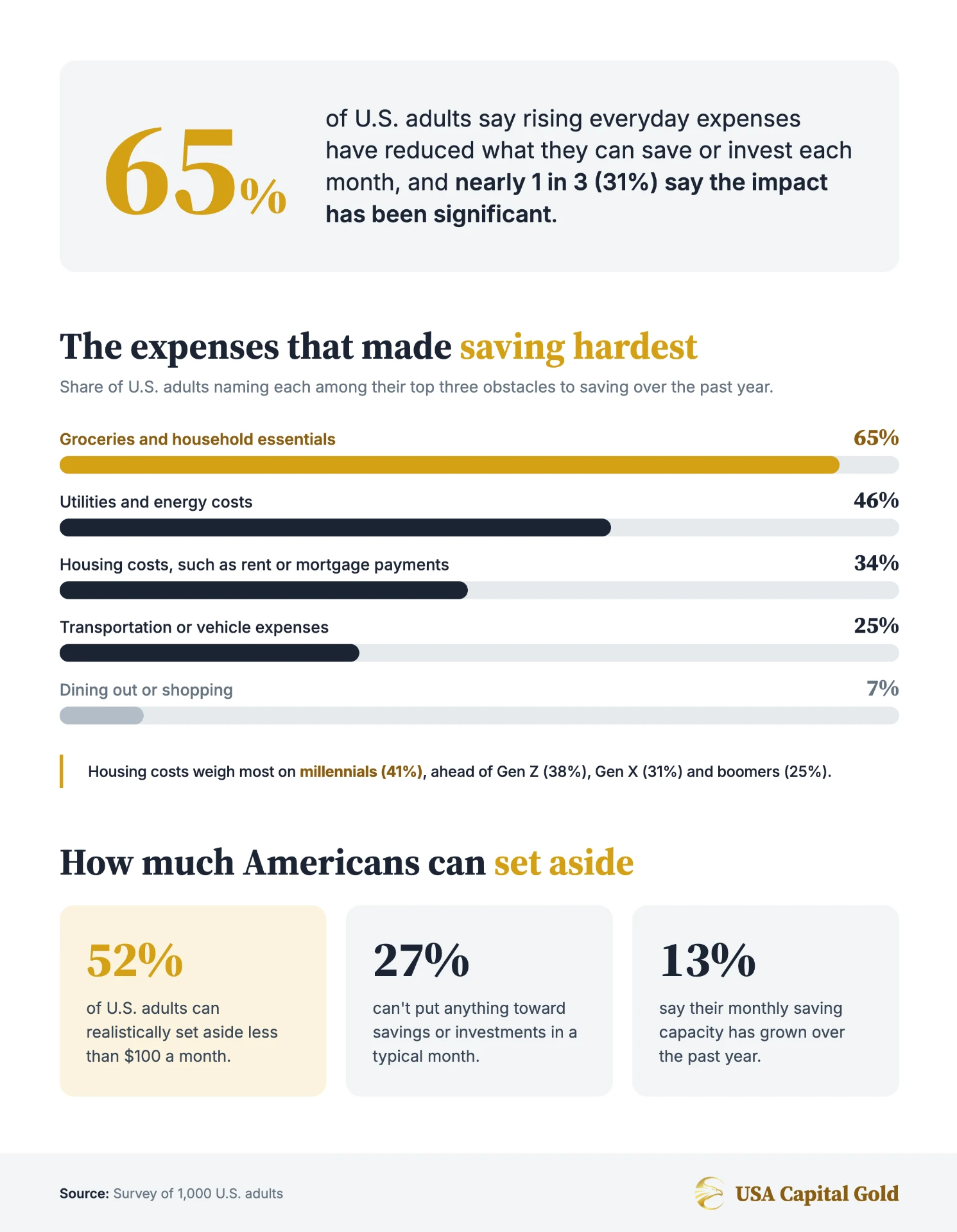
Nearly two-thirds of U.S. adults (65%) say rising everyday expenses have reduced how much they can save or invest each month over the past year, including 31% who say the reduction has been significant. Only 13% report that their monthly saving capacity has grown. Many have no margin left. More than 1 in 4 respondents (27%) can’t put anything toward savings or investments in a typical month, either because their income covers their bills with nothing left over (23%) or because it doesn't cover them at all (4%). More than half (52%) can realistically set aside less than $100 a month, a pace that keeps a savings habit alive but leaves little room to build a cushion against a major surprise.
Asked to name the three expenses that made saving hardest over the past year, those surveyed pointed overwhelmingly to necessities:
- Groceries and household essentials (65%)
- Utilities and energy costs (46%)
- Housing costs, such as rent or mortgage payments (34%)
- Transportation or vehicle expenses (25%)
Few respondents blame discretionary spending, with 7% naming dining out or shopping and another 7% naming travel or vacations. That gap matters. People can skip a restaurant meal, but they can’t skip the electric bill, so the households under the most pressure have the fewest places left to cut.
Respondents of different ages feel that pressure in different places. Housing costs weigh far more on millennials than on boomers, with 41% of millennials naming them among their biggest obstacles to saving, compared with 25% of boomers, a gap that likely reflects the rents and mortgages younger adults have taken on at today’s prices. Boomers are more likely to point to health care or medical expenses (27% vs 14% millennials), costs that tend to climb with age. Women feel the squeeze more sharply than men, too. They’re more likely to say rising expenses have cut into their monthly savings (68% vs. 60%) and to have nothing left over in a typical month (31% vs. 20%), while men are more likely to set aside $250 or more (35% vs. 23%), a split that likely mirrors persistent differences in earnings.
What Happens to Emergency Savings and Retirement When Money Gets Tight
People build an emergency fund so a surprise bill doesn't turn into a crisis, and they build a retirement account for the decades after the paychecks stop. When money runs short, they often have to decide which cushion to thin first. In making that call, they reveal how they weigh safety today against growth tomorrow.
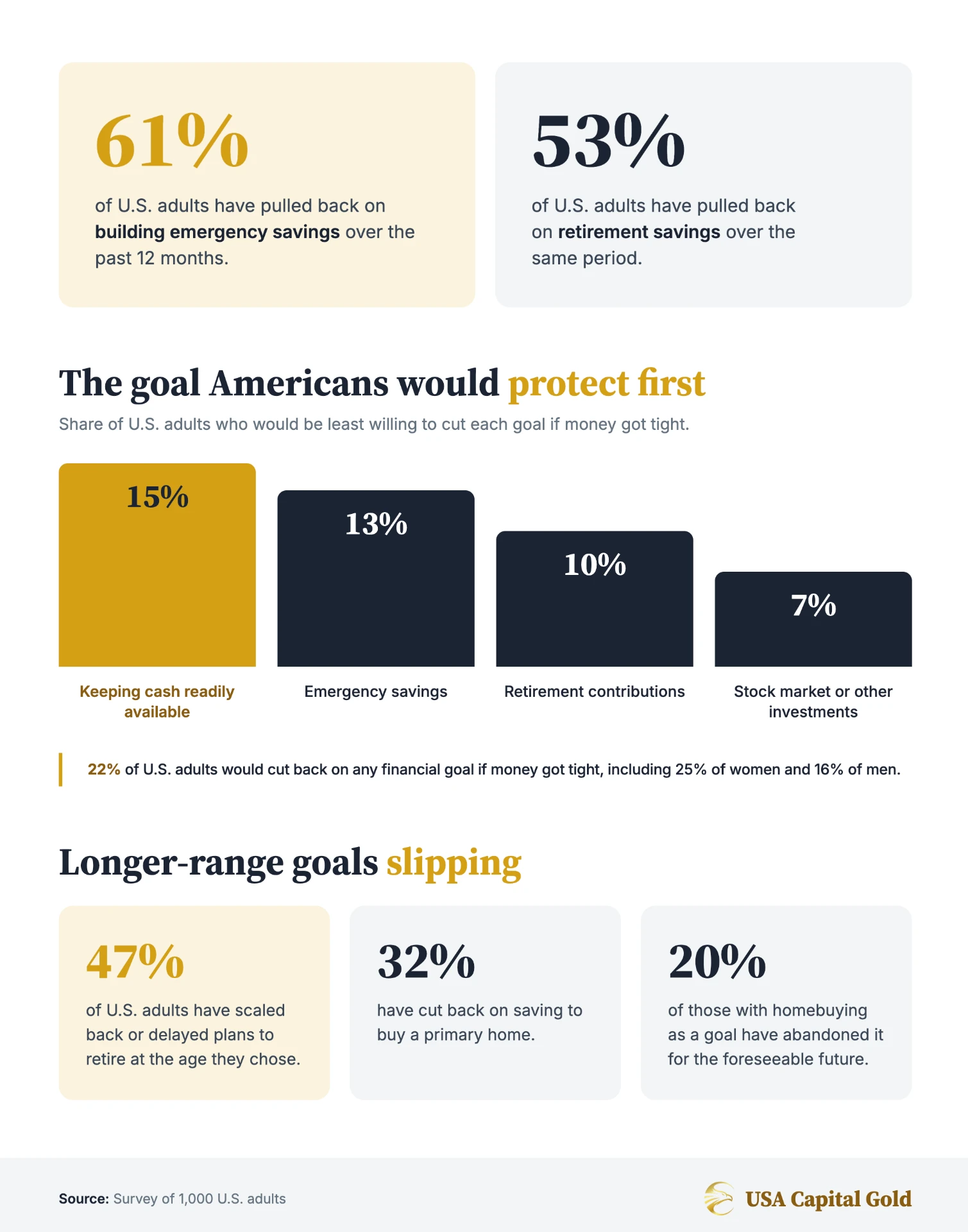
Over the past 12 months, 61% of respondents have reduced, paused, delayed or abandoned building emergency savings because of rising living costs or other financial pressures. More than half (53%) have pulled back on retirement savings, and the same share have cut back on saving enough to retire comfortably. Nearly half (47%) have scaled back, paused, delayed or abandoned plans to retire at the age they had chosen. Savers can pause both goals without an immediate penalty, which likely explains why they cut those first when budgets tighten.
Respondents still know what those cushions are for. Asked which single goal they would be least willing to cut if money got tight, they most often chose liquidity, with keeping cash readily available (15%) and emergency savings (13%) together drawing 28%. Just 10% would protect retirement contributions, and 7% would protect stock market or other investment contributions. More than 1 in 5 (22%) would cut back on any financial goal if money got tight, including 25% of women and 16% of men.
Many have let longer-range goals slip as well. Nearly a third of those surveyed (32%) have cut back on saving to buy a primary home, and among respondents who had homebuying as a goal, 20% have abandoned it for the foreseeable future. Millennials have pulled back on home saving more than Gen X (42% vs. 29%), while boomers are more likely than millennials to have abandoned saving for retirement altogether (15% vs. 7%), a sign that some older savers may have shifted from building their nest egg to drawing on it. Women are more likely than men to have cut back on both emergency savings (64% vs 56%) and retirement saving (56% vs. 49%).
Building Wealth and What It Takes to Feel Financially Secure
Plenty of people want to build wealth. Fewer can turn that intention into a monthly deposit, usually because of what’s left after the bills and how far away the finish line looks. Most people also carry a private number in their heads, the amount that would finally let them feel secure, and they judge whether the goal is reachable against it.
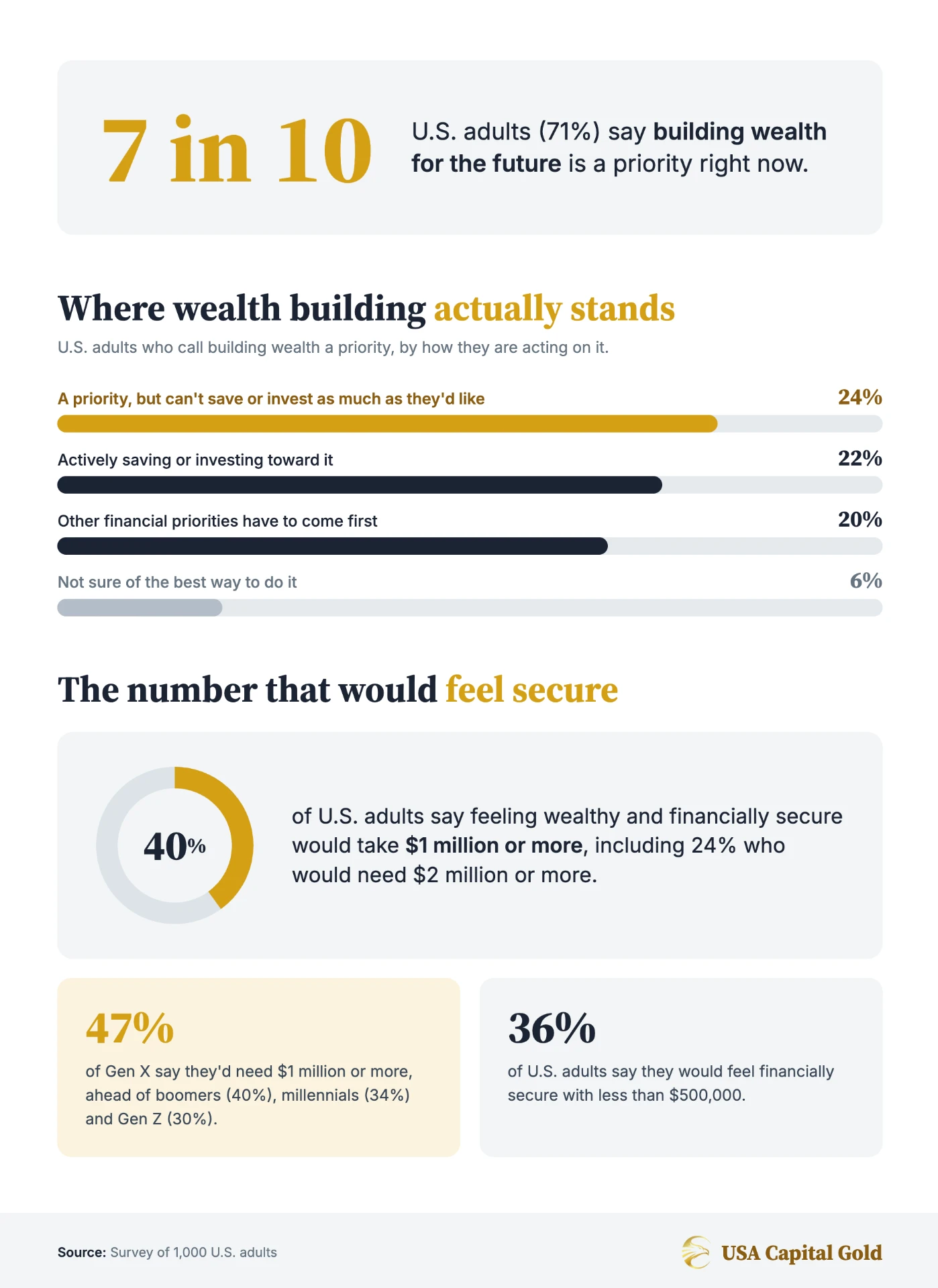
Building wealth for the future is a priority for 71% of U.S. adults right now, yet just 22% say they’re actively saving or investing toward it. The rest of that group is stuck. Another 24% say wealth building is a priority but they can’t save or invest as much as they’d like, and 20% say other financial priorities have to come first. For most, the obstacle is capacity. They want to save, and they can’t find the money. A smaller group (6%) wants to build wealth but isn’t sure of the best way to do it, a gap that clearer guidance could close.
Younger respondents put more weight on building wealth. Among millennials, 78% call building wealth a priority, compared with 59% of boomers, and 41% of boomers say it isn’t a priority right now, likely because many have moved from accumulating savings to living on them. Men are more likely than women to prioritize building wealth (79% vs. 67%) and also more likely to say it’s a priority they can’t fund as fully as they’d like (30% vs. 21%).
Asked what it would take to feel wealthy and financially secure, 40% of respondents said $1 million or more, including 24% who would need $2 million or more. More than a third (36%) would feel secure with less than $500,000, and 9% aren’t sure. Gen X sets a higher bar than millennials, with 47% saying they’d need $1 million or more, compared with 34% of millennials, likely because Gen X are closer to retirement and thinking harder about how long their savings must last. At the other end, 43% of millennials would feel secure with less than $500,000. Measured against what most people can set aside each month, a seven-figure target can feel remote, which may help explain why so many respondents treat wealth as a priority they can’t yet act on.
Generational Attitudes Toward Building Wealth
Every generation inherits a financial playbook from the one before it, usually built around homeownership and a steady march toward retirement. Many younger adults now look at that playbook and see milestones priced beyond their reach. They’re rewriting it. Sometimes by accepting more risk and sometimes by redefining what wealth means in the first place.
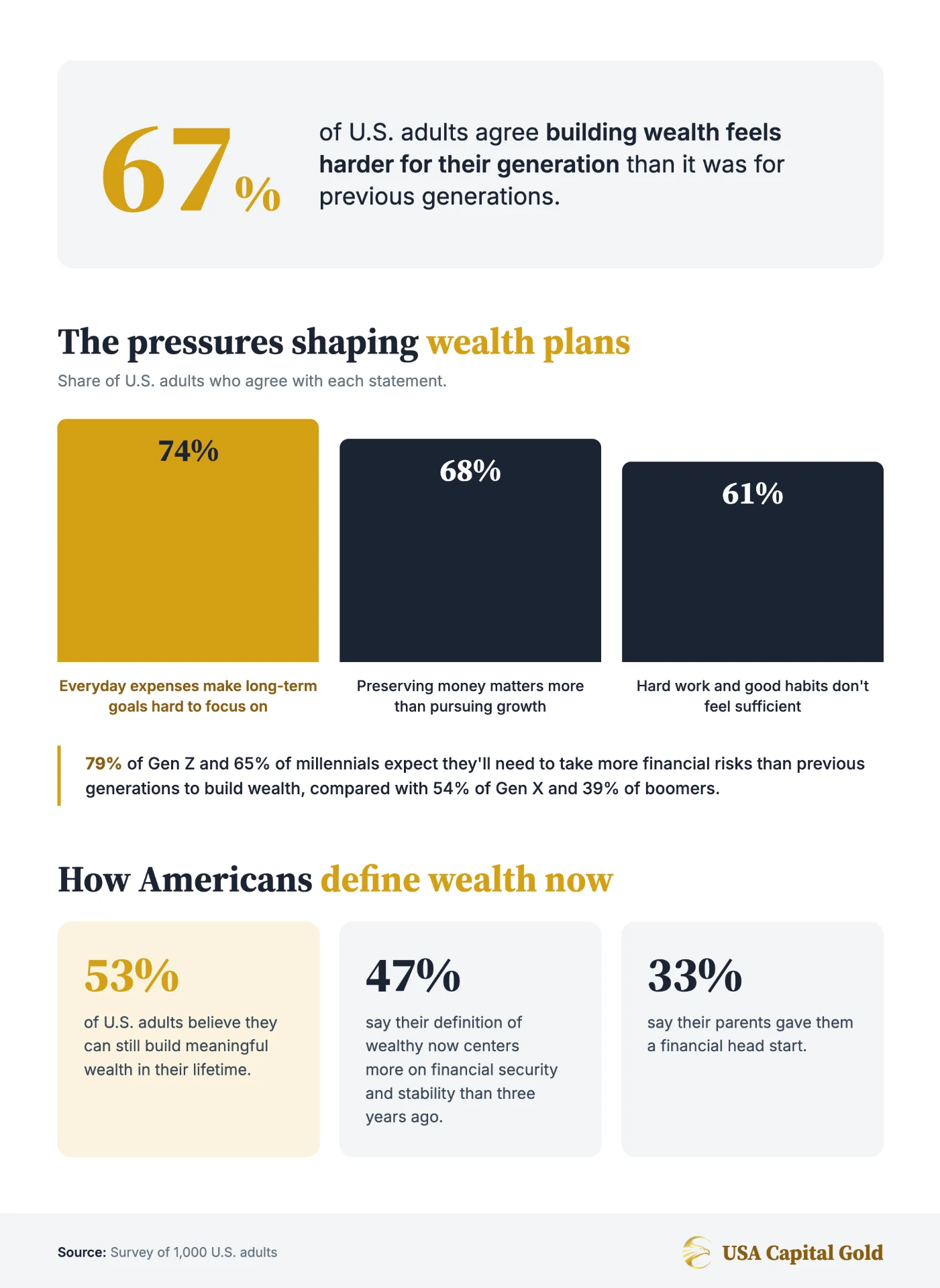
Two-thirds of respondents (67%) agree that building wealth feels harder for their generation than it was for previous generations. Among millennials, 79% agree and 47% strongly agree, compared with 52% and 22% of boomers. More than 6 in 10 (61%) say hard work and responsible financial habits don’t feel sufficient to get ahead, and 57% have stopped planning around some traditional financial milestones from their plans (64% vs. 42%), likely reflecting the steeper price tags they’ve faced on homes and other markers of financial adulthood. Nearly three-quarters (74%) say keeping up with everyday expenses makes it difficult to focus on long-term goals.
When it comes to risk, respondents pull in two directions. More than two-thirds (68%) say preserving the money they already have feels more important right now than pursuing higher investment growth, and 67% value having enough emergency savings over maximizing returns. Younger and older respondents alike lean toward preservation, with 67% of millennials and 70% of boomers agreeing. Yet 57% expect they’ll probably have to take more financial risks than previous generations did to build wealth, a view held by 65% of millennials and 39% of boomers. Respondents who hold both views aren’t contradicting themselves. Many want a secure floor under their money before they reach for growth.
Plenty still see a path forward. Just over half (53%) believe they can still build meaningful wealth in their lifetime, including 60% of millennials and 42% of boomers, though men feel more confident than women (63% vs. 47%). Compared with three years ago, 47% say their definition of being wealthy now centers more on financial security and stability, while 10% say it focuses more on accumulating assets. Respondents also start from different places. A third (33%) say their parents gave them a financial head start, while 21% of millennials say their parents put them at a financial disadvantage, compared with 10% of boomers.
How Americans Plan to Pay for the Holidays
People tend to feel a year’s worth of financial pressure all at once in November and December. They have to cover gifts and travel on a fixed deadline, whether or not the rest of the budget has room. By choosing how to pay for the season, they also decide which pressures they’ll carry into the new year.
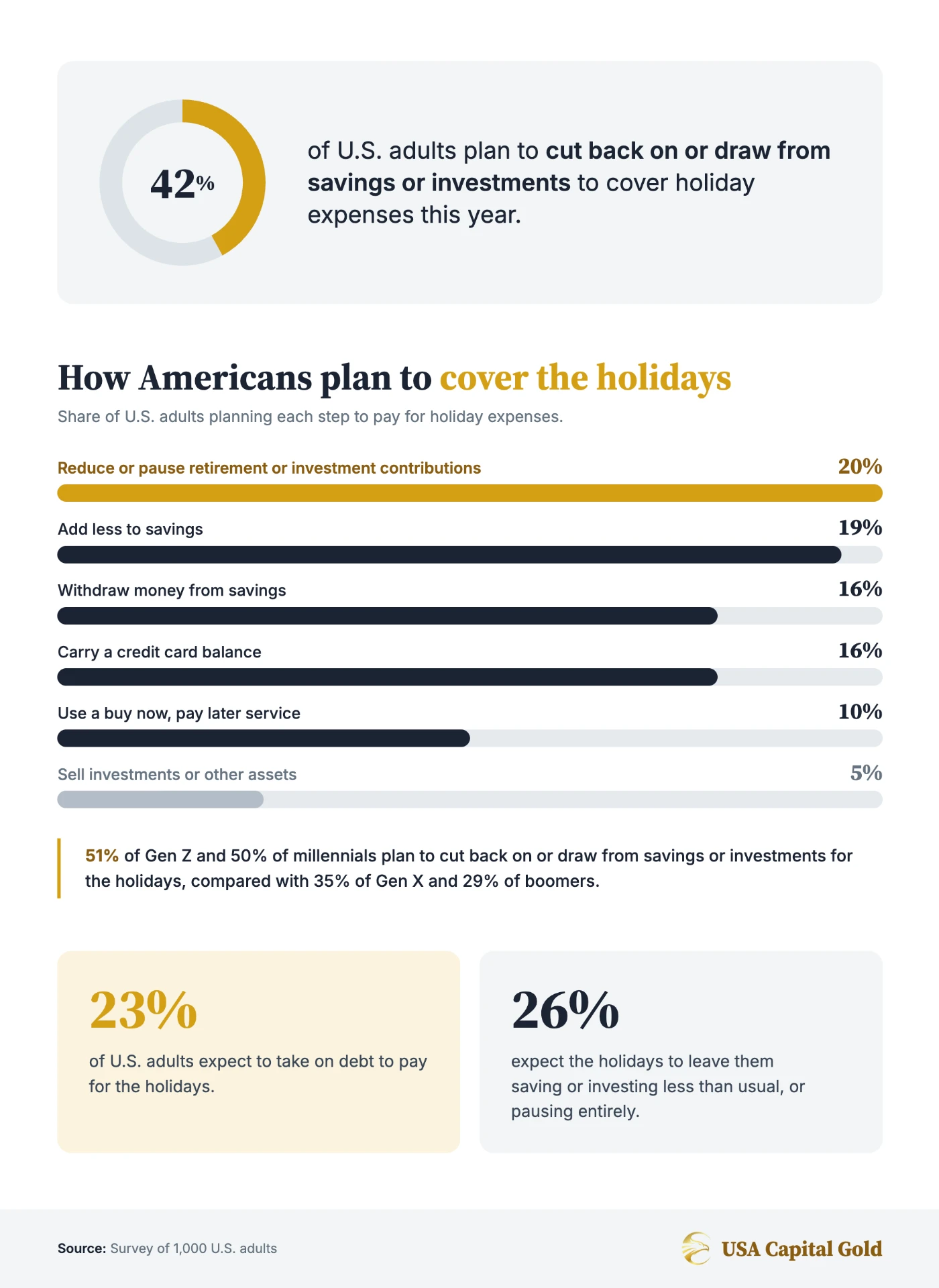
To cover holiday expenses this year, 42% of U.S. adults plan to cut back on or draw from savings or investments. That includes 20% who expect to reduce or pause retirement or other investment contributions, 19% who will add less to savings, 16% who plan to withdraw money from savings and 5% who intend to sell investments or other assets. Others plan to borrow. Nearly a quarter of respondents (23%) expect to take on debt for the holidays, most often by carrying a credit card balance (16%) or using a buy now, pay later service (10%). Shoppers who carry a balance past January trade a few weeks of celebration for months of catching up, and more than a quarter of those surveyed (26%) already expect the season to leave them saving or investing less than usual or pausing entirely.
Millennials lean on their savings far more than boomers do. Half of millennials (50%) plan to tap or trim savings or investments to cover the holidays, compared with 29% of boomers, and 24% of millennials plan to reduce or pause retirement or other investment contributions, compared with 9% of boomers. On debt, 27% of millennials expect to borrow for the holidays, compared with 16% of boomers. Boomers are more likely to cover the season with current income without changing their other financial habits (16% vs. 7% of millennials), likely because many have had more years to build a cushion. Millennials are also more likely than boomers to expect to save or invest more than usual over the holidays (26% vs. 5%), which may point to a generation splitting between savers who are stretched and savers who are getting ahead.
Men and women plan to absorb the cost in different ways. Men are more likely than women to cut back on or draw from savings or investments for the holidays (46% vs. 38%), including reducing or pausing retirement or investment contributions (24% vs. 16%). Women are more likely to trim holiday and other discretionary spending (44% vs. 34%), protecting their savings by adjusting the budget itself.
Gold, Precious Metals and Diversifying a Retirement Portfolio
People have treated gold as a store of value for thousands of years, and they tend to look at it more closely when they lose confidence in the dollar or the broader economy. Savers who have spent the past year protecting what they have now face a practical question about how much of a long-term portfolio belongs outside stocks and cash.
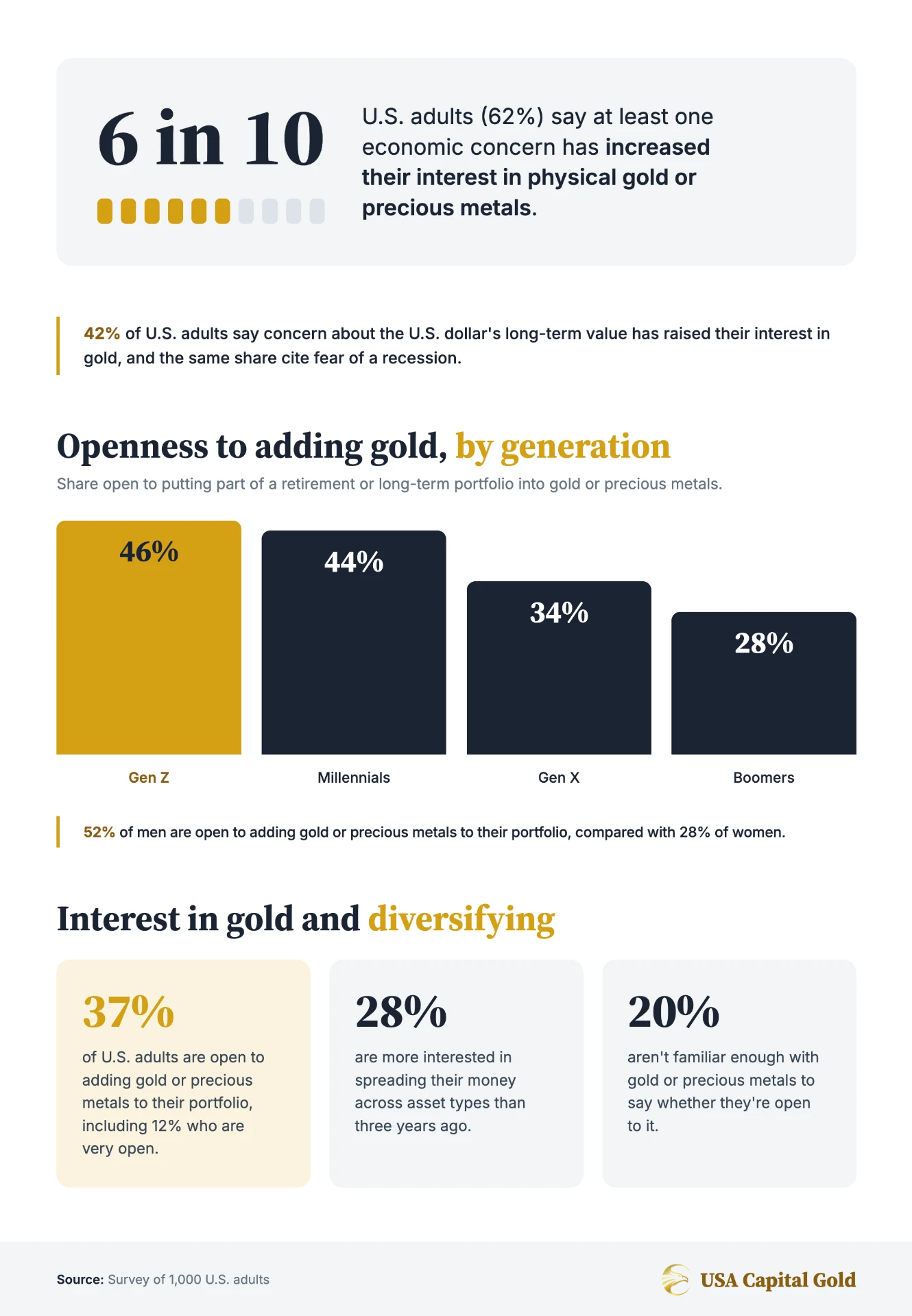
Few say any of these concerns has cooled their interest, with no more than 13% reporting less interest for any single concern. Respondents react most strongly to worries about the dollar and the broader economy, which may reflect gold’s long-standing reputation as an asset that sits outside both.
More than a third of those surveyed (37%) are open to allocating part of their retirement or long-term portfolio to physical gold or precious metals, including 12% who are very open. Another 20% aren’t familiar enough to say, an answer that points to a knowledge gap as much as a preference. Compared with three years ago, 28% are more interested in spreading their money across different types of assets, while 15% are less interested. Not everyone has acted on that interest, though. Over the past 12 months, 28% have reduced, paused, delayed or abandoned investing in alternative assets such as precious metals or cryptocurrency, while 5% have increased it. Many are likely running into the same constraint that has thinned their emergency funds, with less money left to put anywhere.
Men and women split sharply on gold. Men are more likely than women to say at least one economic concern has raised their interest (71% vs. 56%), and the gap is widest on inflation, which has made 50% of men and 29% of women more interested in physical gold or precious metals. On portfolio allocation, 52% of men are open to adding gold or precious metals, compared with 28% of women. Part of that gap appears to come down to familiarity, since women are more likely than men to say they don’t know enough to weigh in (24% vs. 14%). Millennials are more open than boomers to adding gold (44% vs. 28%) and more interested in diversifying than they were three years ago (34% vs. 20%), which may reflect a generation that expects to take on more risk looking for a counterweight to it.
How to Protect What You Have While Still Building Wealth
Americans haven’t given up on building wealth. They’ve reordered the steps. Faced with bills that leave little room to spare, many are securing a floor under the money they already have before they reach for growth, and that instinct reflects sound planning.
Savers run into trouble when a defensive year stretches into a defensive decade. Anyone who pauses retirement contributions or taps an emergency fund to get through the holidays gives up time that’s hard to recover, and younger savers give up the most, since time is their biggest advantage.
Protecting what you have and growing it don’t have to be competing goals. People can serve both by rebuilding the emergency fund first and then diversifying a retirement portfolio across assets that behave differently in a downturn. Those weighing how a Gold IRA or other physical metals might fit into that plan can start by deciding what they want to protect and why. The households that come through this stretch strongest may be the ones that treat protection as the foundation of their wealth plan.
Methodology
USA Capital Gold surveyed 1,000 U.S. adults through Pollfish in 2026 to explore how economic pressure is affecting the way they save and invest for the future. The survey covered monthly saving capacity, financial goals respondents had cut back on, attitudes toward wealth and risk, holiday spending plans and interest in physical gold and precious metals. The sample was stratified and segmented by age and gender. Results are post-stratified where available; unweighted results may be used for certain subgroup analyses where stratification is not possible. Generational comparisons cover Gen Z (ages 18 to 29), millennials (ages 30 to 45), Gen X (ages 46 to 61) and baby boomers (ages 62 and older). Percentages may not total 100% due to rounding, and may exceed 100% where respondents could select multiple answers.
About USA Capital Gold
USA Capital Gold is a veteran-owned precious metals firm that has helped Americans protect their retirement savings since 2008. The company specializes in Gold IRAs and rollovers, guiding clients as they move funds from existing retirement accounts into IRS-approved physical gold and silver held in insured depositories.
Fair Use Statement
The information in this article may be used for noncommercial purposes only. If you share it, please credit USA Capital Gold and include a link back to this original research with proper attribution.